


When you’re advising small businesses, you’re often dealing with owners who are too close to the action. They know their business by heart but not necessarily by data. That’s where the SWOT analysis steps in — and where BuzzBoard’s intelligence gives it a serious upgrade.
Every small business wants to grow. But before you can chart a growth plan, you have to know where the business stands — what’s working, what’s not, and what’s waiting to be tapped. We know that the ecosystem of small and medium businesses (SMBs) is inherently turbulent. For those in the strategic trenches — the firms dedicated to not just selling marketing services but also building profitable, sustainable futures — the diagnostic phase is paramount.
But let’s face it: the traditional SWOT grid can feel like an MBA exercise trapped in a Word doc. For a world powered by AI and personalization, your SWOT must evolve from a generic checklist into a dynamic strategy blueprint. And this is where BuzzBoard’s culture takes hold: we don't tolerate guesswork; we support actionable intelligence.
By layering local market intelligence, digital presence benchmarks, competitive positioning, and more exclusive metrics sourced from over 30 million small business profiles, BuzzBoard gives your consulting process the kind of depth traditional research can’t touch.
We are turning static analysis into strategic foresight, transforming your role from consultant to growth navigator, and helping every small business client see exactly where they stand — and where to move next. Let’s amp you up with data-driven confidence.
What is a SWOT analysis?
A SWOT — Strengths, Weaknesses, Opportunities, and Threats — analysis is a formidable diagnostic tool that is used for small business consulting, helping consultancies or service providers to assess a business’s current situation by examining these four key dimensions to inform strategic decisions. When consulting with small businesses, use a SWOT analysis to:
Strengths – What the business does well; its internal advantages, capabilities, or assets (like brand reputation, loyal customers, or unique offerings).
Weaknesses – Internal limitations or areas where performance lags (such as lack of resources, outdated technology, or inconsistent marketing).
Opportunities – External factors the business can leverage to grow (emerging market trends, new customer segments, competitor gaps, or regulatory shifts).
Threats – External risks or pressures that could impact performance (like new competitors, economic downturns, or changing consumer behaviors).
In the context of small business digital marketing consulting, a SWOT analysis helps you:
How to conduct a SWOT analysis for small to medium businesses: A step-by-step guide
Step 1: Identify strengths
Step 2: Flag weaknesses
Step 3: Highlight opportunities
Step 4: Detect threats
Step 5: Analyze and prioritize
Why SMB SWOTs are different
When you consult with an enterprise, you are analyzing a battleship: slow to turn, but heavily armed. When you consult with an SMB, you’re analyzing a speedboat: incredibly agile, yet susceptible to even the smallest rogue wave.
The difference in scale dictates a shift in perspective:
Your role as the consultant is to provide the strategic intelligence to differentiate between these issues and their remedies.
The BuzzBoard augmentation: From checklist to diagnostic dashboard
A robust SWOT isn’t just a starting point; it’s the backbone of an ongoing advisory relationship. BuzzBoard elevates this work by transforming a traditionally manual exercise into a dynamic, automated, intelligence-driven diagnostic system.
BuzzBoard’s auto-generated SWOT analysis and strategy guides draw from deep local market intelligence, digital benchmarks, and competitive signals to give consultants a richer, more nuanced assessment of each client’s strategic landscape. Instead of relying on interviews, research, and assumptions, you’re equipped with a data-backed view of where the business truly stands — and where intervention will create the highest return.
Within a consultation engagement, this becomes the engine for your advisory work.
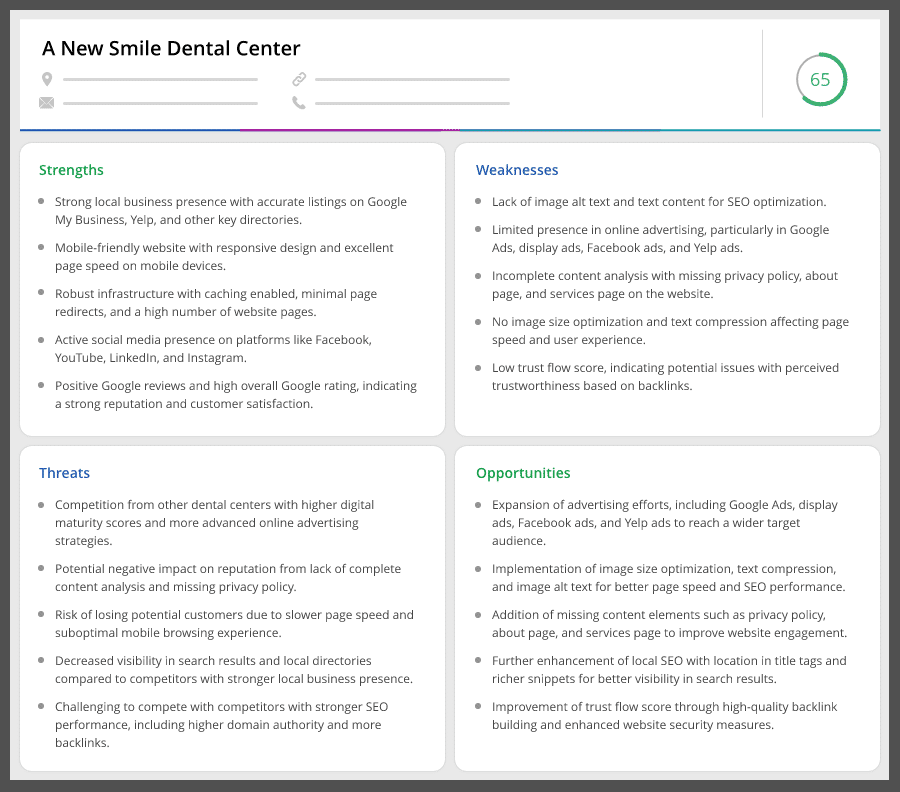
Once you have a clear understanding of the customer’s situation, further analyze their digital deficiencies. Identify areas where your firm’s expertise can make a significant impact on their business. Develop a highly customized strategy and action plan that outlines the initiatives most likely to produce measurable outcomes for the client. This becomes an advisory playbook — not a sales proposal — and guides your work across quarterly reviews, campaign cycles, and performance check-ins.
But in order to start the right service with them, you will need to pay attention to details and not be hasty in prescribing solutions. The goal of the consultation is to understand the client’s operating reality deeply enough to recommend interventions that are both actionable and sequenced for maximum impact.
Strengthen your consulting by using comparative insights reports that contextualize your client’s performance within their local competitive landscape. These comparison reports spark alignment, clarify priorities, and help clients understand where strategic attention is most needed.
BuzzBoard Ignite assists SMB-focused consulting by enabling efficient and best-matched competitor analysis for its customers. BuzzBoard has its own matching algorithm to surface competitors based on proximity to your client's business’s physical location, its service offerings, business operations, and digital maturity. Ignite’s competitive intelligence layer complements your SWOT analysis by giving you a continuously updated view of the client’s competitive terrain.
For a deeper dive and a comprehensive marketing strategy, BuzzBoard Ember automates competitive benchmarking so it becomes a consistent strategic input, not an occasional check-in, informing quarterly reviews, content planning, budgets, and channel priorities. Then it turns these insights into an actionable rhythm: strategy plans that outline a clear roadmap, customer insight reports that surface brand gaps and growth opportunities, monthly progress reports that show real movement, and renewal briefs that anchor long-term value. Together, they keep clients aware of their competitive reality and help them anticipate pressures instead of reacting to them.
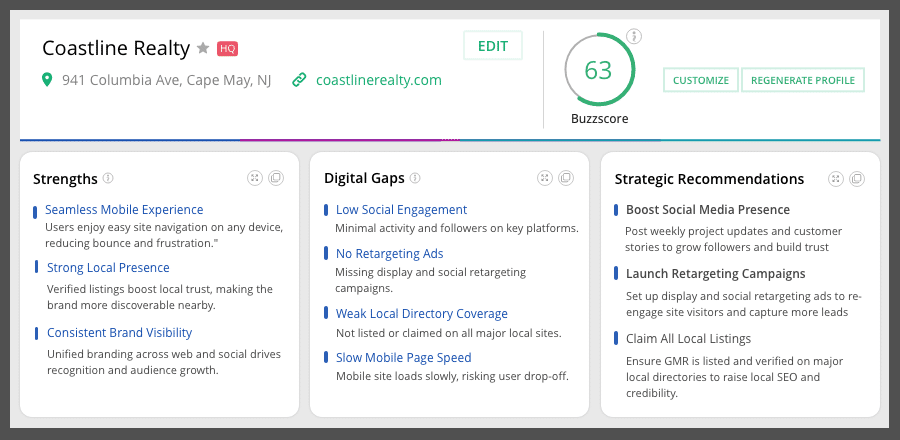
In small business consulting, the true advantage lies in transforming scattered observations into strategic clarity. A well-executed SWOT analysis is more than a diagnostic… it's the compass that helps firms guide clients through shifting markets, operational blind spots, and competitive noise.
When consultants pair structured analysis with intelligence-rich inputs, small businesses gain:
Consultants who leverage deeper insight elevate the conversation, help SMBs make braver, better-informed decisions, and ensure that every move forward is intentional, not incidental.